Town of RozellvilleHonoring Our Past, Building Our Future
Commemorating 145 years of The Town of Day.
By Steve Bornbach.
Wisconsin had been a possession of France since 1671 under the authority of King Louis the 14th. At that time New France stretched from Montreal, Canada and along the Mississippi River all the way to the Gulf of Mexico. The economy of the region was powered by the fur trade of which the natives were a part.
Wisconsin was once a territory that saw many conflicts in the struggle between England and France for control of the land. Moreover, there were also hostilities among the indians. All of that affected the area of what would become Marathon County and The Town of Day.
There were many indian tribes in Wisconsin Territory. Sioux, Ojibwa, (Chippewa) Ho-Chunk, (Winnebago) Sauk, Fox, and Menominee. The Potawatomi filtered through the area later after being forced out of south eastern Wisconsin. The Sioux claimed and exercised jurisdiction over much of the country. However, it was the Chippewa that controlled the northern third of Wisconsin Territory from Lake Superior on southward to, and through Marathon County.
There were under currents of tension between native groups of people which led to hostilities such as the Battle of Smokey Hill in Green Valley, east of Rozellville in the mid 1700’s. The story of that battle was relayed by Peter Chaurette to Michael W.D. Rozell, Nicholas Pinion, John Brinkman, Sr. and to many other settlers. Mr. Chaurette was educated in Montreal. His father, Simon Chaurette, was a french soldier who knew of the battle. Peter’s mother was Marguerite Chaurette ( born Keeshkemon) born in 1774. Her father was Chief Keeshkemon, most powerful of the Chippewa, and located at Lac du Flambeau.
Many fur traders like Simon Chaurette, Paul Grignon and John Baptiste DuBay, married into families of tribal chiefs in order to gain favor for trapping. Later, they opened trading posts and eventually capitalized on logging interests.
Wisconsin Territory was growing by leaps and bounds in the 1840’s and became a state in 1848. The need for lumber became more important than ever. Treaties were made and indians were removed from their lands, quite often to other states. But over time many returned and began a new life.
Massive white pines were cut down along the Wisconsin River beginning with Daniel Whitney in 1831-32. Others followed in clearing pines from northern Adams County all the way to Big Bull Falls (Wausau) and beyond to the north. But at Little Bull Falls (Mosinee) trees were cleared moving west up the Little, and Big Eau Pleine Rivers.
Andrew and John Week built a saw mill on the Big Eau Pleine River in 1849. Local settlers from Campbell Settlement were employed there. Men like Michael W.D. Rozell, Samuel Campbell, and George Beach. The 1913 ‘History of Marathon County’ lists those families as being in an area currently known as Day by 1868.
Nicholas Pinion had already arrived to this area by boat in the 1850’s. He built a cabin along the Little Eau Pleine River, a spot that later took the name Pinion Rapids. Pinion erected a sawmill which was later purchased by Andrew Daul.
In the late 1800’s Central Wisconsin experienced rapid settlement driven by a booming lumber industry, cheap government land for as little as $1.25 per acre, and arrival of railroads. Central Wisconsin Railroad and Green Bay & Western were vital to bringing settlers into the region. Some of the earliest family members to arrive were:
Casper Ably, Nick Benz, George Beach, Andrew Daul, Matt Folz, Christ Franzen, Jacob Hoffman, Anton Kiefer, Nick Oppermann, William Raschke, Jacob Reichert, Nick Rehlinger, Peter Replinger, Leonard Schmitt, Simon Strigel, John Stadt, Adam Sturm, Charles Veers, Jacob Young, and many others by the 1890’s.
There was an influx of many settlers and soon there was a village with stores, saloons, a church, and other signs of civilization. After much controversy that little hamlet became Rozellville, a hub in the Town of Day.
Rozellville 2026
What’s In A Name?
…..an Indelible Imprint.
By: Patti Laessig
The earliest settlers of the Rozellville area were the local band of Potawatomi Indians. John Young was their chief. They lived nestled in the forest in their dwellings made of hides of animals and sapling trees harvested from their surroundings. They lived a modest life, living off the land. This band traveled between the “Indian Farm” as it was later called by the white folk that settled there, and settlements in the Tomahawk area, stopping by the Big Eau Pleine River which at the time was a settlement created in the late 1800s by the Weber brothers, Christian and Henry who migrated from Manitowoc County, whose origin was a village near Trier, Germany. The settlers and “Indians” were friendly to one another, sharing goods and remedies for healing, made from the local plants. One was a “drawing salve” made of pine pitch and herbs harvested from the land. The salve as its name suggested, drew out splinters, infections, and whatever ailment that required first aid.
Anna Brinkman Kloos, (05 Feb 1887-21 Sep 1989) daughter of John Brinkmann (30 Jul 1847-22 Oct 1919) and Caroline Daul (22 Jan 1854-09 Mar 1939) worked in her father’s store at the crossroads of Rozellville. Caroline came from Milwaukee, and John originated in Baden, Germany. Anna did the office work as well as other duties, including waiting on her native friends. They’d point to whatever it was they wanted, such as “cees-back-wart,” sugar, “Kree-she can, Samma,” their words for various items. The women would ride to the store on their ponies with their baby strapped to their back to do their trading. Anna would often go back with them to their home in the woods. She said it was solid woods where the Indians lived in wigwams, surrounded by trees where no breeze penetrated the dense forest.
Often the Indians would get company from Kansas who traveled by horseback. The government relocated the local band from this area when the natives were not able to pay taxes on their land. Dances were held to celebrate the visitors in a huge circle where they donned their regalia and danced to the beat of their drums.
The post office was located in the back of Brinkmann’s store. Communication with distant relatives and friends was part of their life as mail carrier Matt Brausch delivered their messages back and forth, to and from the outside world, traveling in his stagecoach. In earlier times, George Beach walked to Marshfield and carried the mail in his back pouch before there was a road, only a trail between Rozellville and Marshfield.
Father Rudolph Raschke, born and raised in Rozellville, (22 Mar 1893-28 Aug 1985) son of William and Pauline (Benz) Raschke, told of his dad traveling from the east with his sawmill on a wagon, taking the Week’s Road that lumberman John Weeks created that came out north of Rozellville. His dad, William Raschke and August Kroening had the contract to cut the timber along the trail from Rozellville to Marshfield when Highway 97 was laid out. This original route remains today.
Michael W. D. Rozell, the village’s namesake left his name on this quaint town in the heart of central Wisconsin, however he did not stay in the town bearing his name. He and his wife, Betsy along with some of their family, moved to Plainfield, Wisconsin, but later he returned to live with his son, Elmer. He was born 12 February 1803 in Fishkill, Dutchess County, New York, the son of Jeremiah and Deborah Rozell. His wife Elizabeth (Bacon) ‘Betsy’ was born 26 June 1805 in New York to Barbara (Councilman) and Abner Bacon. Betsy died 2 June 1871 and is buried in the Plainfield Cemetery, in Waushara County, Wisconsin, along with her husband Michael who died in Rozellville on 18 April 1896. After the death of his wife, Betsy, Michael married Jane Philena Alexander Banks (1819-1897) who is also buried in the Plainfield cemetery along with her first husband Henry W. Banks (1870-1869).
Another name that appears in the early records of Rozellville is Campbell. The Campbell name is known for their musical contribution to the area, via their band which included many of the local musicians; Frank, Andrew and Peter Daul, William Raschke, John Benz, Anton Lax and Casper Ably. Brothers Sam and Henry Campbell were early settlers in the area, as well as George Beach and family.
Rozellville’s blacksmith, Fredrich Herman Klumb was an integral part of the community, providing services to the residents of the area. He was born 21 Sep 1860 in the town of Jackson in Washington County, Wisconsin to Phillip and Dorotha (Schmahl) Klumb, immigrants from Germany. He and his wife Emma Jaeckel (18 May 1863-27 May 1927) were early occupants of Rozellville. Fred’s blacksmith shop is still standing, having been converted over the years to a night club, namely “Paris Avenue,” and now “The Buck-A-Neer.”
Farmers depended on their horses to provide not only transportation, but also to plow their fields in preparation for their crops and harvesting, thus the blacksmith was a necessary service provider in those early days. He not only provided service to the horses, but was also a handyman who repaired wagons, pump handles, buggies, and even household utensils, as his daughter Marie Klumb Zuelke told of the pancake turner he made for her. Fred also knew the people didn’t always have the money to pay him, so he accepted whatever trade they offered in return for his work. Bartering was an essential part of his business. Later, after Stratford was established north of Rozellville on Highway 97, Klumb relocated his business to that town. He died there 04 Jan 1926.
These and many other families came to settle this tiny cross-roads town to establish not only their homesteads, but to put down their roots, deep into the soil, investing their lives and livelihoods in the town and its surrounding parameters. The farmers, the merchants, the saloon proprietors, were the backbone of the village.
Devout religious leaders shared their faiths with communities like Webertown to the northwest, bringing hope and serenity of peace in the knowledge of a divine source to ease the burdens of life on Earth. Services were held in homes in those days, as congregations were small and churches were not yet built to accommodate them. Pastors would travel between the settlements to serve the parishioners. 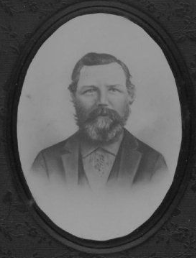
Michael W.D. Rozell Michael W.D. 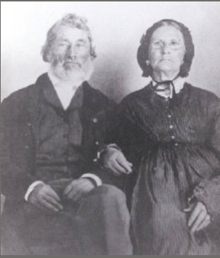
Rozell & Elizabeth ‘Betsy’ (Bacon) Rozell
The original folks who made their home in Rozellville left not only their names carved into church cemeteries’ tombstones, but in their descendants who remain here, and those who have their deep roots here but have branched out to make their way in the outside world but look back on a small crossroads village that their heartstrings pull them back towards: their ancestral home.
Some Rozellville area names include the following:
Ably, Adams, Albrecht, Altman, Adreas, Aschebrook, Aschenbrenner, Austin, Bacus, Baltus, Bangart, Bargander, Bartz, Beach, Bean, Beining, Bell, Benz, Bernitt, Beyel, Borchardt, Bornbach, Brandt, Brausch, Breu, Brill, Brinkmann, Brost, Bubbers, Burgraff, Burkhardt, Campbell, Carolfi, Condon, Connor, Daul, Denk, Dennee, Derfus, Draxler, Drexler, Estringer, Fahey, Fischer, Fochs, Folz, Franzen, Frieders, Gall, Gebeline, Geherke, Geiger, Gessert, Grassel, Grassl, Griesbach, Grossbier, Guldan, Hansen, Hardinger, Harter, Hartle, Hauke, Hebert, Heier, Hennes, Hilgemann, Hirsch, Hoefs, Hoffman, Hollatz, Hougum, Huebner, Hughes, Hutchinson, Illig, Jaeckel, Johnson, Junemann, Jung, Kaiser, Kann, Karl, Kaufmann, Kelnhofer, Kennedy, Kiefer, Kipp, Kirsch, Klemme, Kloos, Klumb, Knutson, Koch, Koenig, Kohlbeck, Krall, Kraus, Kremer, Kress, Kroening, Krostag, Kuehlman, Kuehlmann, Kundinger, Kurtzweil, Lang, Leick, Linzmeier, Mader, Maguire, Martin, Masanz, Matti, Meidl, Merkel, Merkes, Meyer, Miller, Mueller, Nickolai, Nikolai, Oertel, Oesau, Offer, Olson, Oppmann, Ott, Ottelein, Pankratz, Patrie, Peters, Petri, Pingel, Pinion, Poeschal, Polivka, Ponchock, Pongratz, Prill, Punswick, Raschke, Rehlinger, Reichert, Reif, Ress, Rink, Rozell, Rudi, Rudie, Sargent, Schaefer, Schalk, Schallock, Schermetzler, Schieber, Schmid, Schmidt, Schneider, Schroeder, Schultz, Seidl, Seitz, Sell, Seubert, Spindler, Stauber, Steines, Stockheimer, Stoiber, Streveler, Striegle, Stueber, Swensen, Teska, Theisen, Theurer, Thon, Treankler, Treutel, Van de Loo, Veers, Wagner, Weber, Week, Wehe, Weichelt, Weigel, Weis, Wellhoefer, Willis, Wolf, Wunsch, Wurl, Young, Ziegler, Zimmermann.